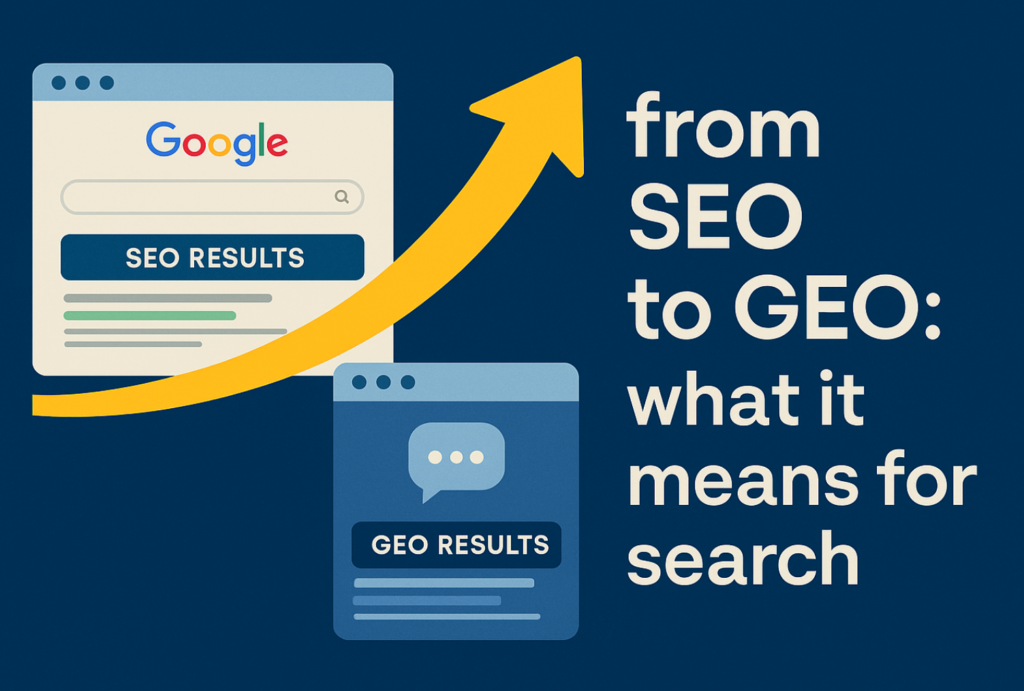
For years, businesses have relied on search engine optimisation (SEO) to get found online. ranking high on google meant more visibility, clicks and ultimately, more customers. The formula was pretty simple: optimise your website with the right keywords, build backlinks, and make sure your site was fast and mobile-friendly.
But search is changing forever, as you’re reading this.
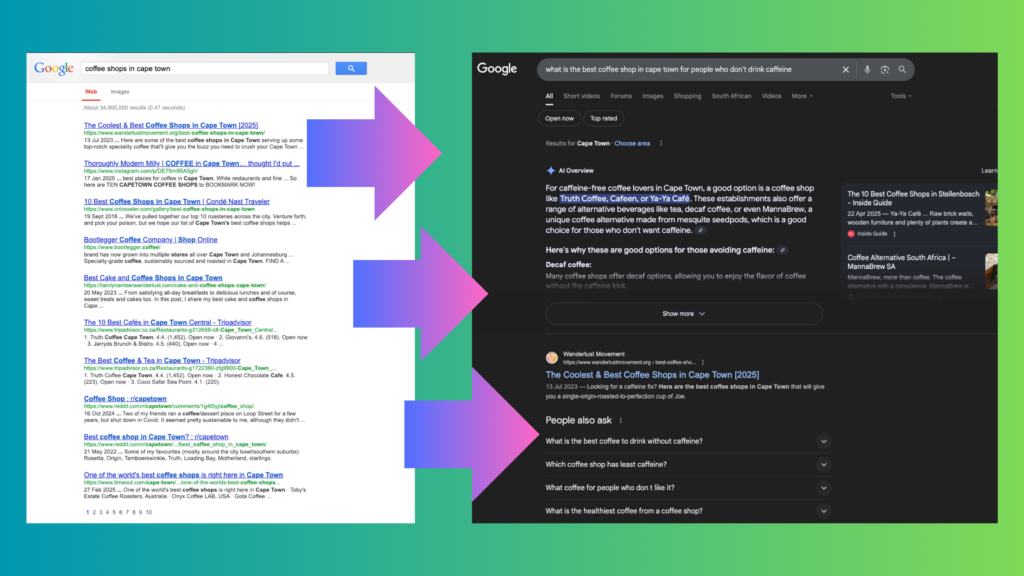
Generative AI (think ChatGPT) is transforming how people find information, and search engines are no longer just ranking links, they’re generating answers pulled from multiple sources on the internet, aggregating and summarising them. You have probably seen this already: Google’s traditional list of blue links are being pushed further down on the Search Engine Results Page by “AI-overview” responses, meaning businesses are losing precious real estate on the first page (because when was the last time you checked the second page on Google?)
GEO, similar to SEO, is about optimising your website (and its content) in order to be the result that comes up when a potential customer searches for your services. However, where the two begin to differ is that AI-driven search results return answers, instead of just links, and these answers are sourced from various websites on the internet.
It’s this shift that has led to this new term: Generative Engine Optimisation (GEO).
So what does this change mean for your website and business? How can you make sure your business remains visible? Let’s break it down.
the shift from seo to geo
GEO, similar to SEO, is about optimising your website (and its content) in order to be the result that comes up when a potential customer searches for your services. But remember, where the two begin to differ is that AI-driven search results return full on answers, instead of just links, and these answers are sourced from various websites on the internet.
Search engines used to be simple directories, organising and ranking pages based on keywords and links. Businesses could create keyword-optimised content, and as long as their site was technically sound, they had a good shot at ranking on page one.
Now, with tools like Google’s Search Generative Experience, ChatGPT, and a whole host of AI platforms popping up, search results have shifted from the list of blue links we’ve come to expect, to direct AI-generated answers right at the top of the page. In effect, these AI models summarise content, providing instant responses to queries.
All of this means that people are increasingly not even visiting a website to get the information they’re looking for. Instead, they’ll interact with the AI-generated content that pulls from multiple sources, ultimately making traditional SEO rankings less important.
why does any of this matter?
User search behaviour is shifting quickly as a result of these changes, with many gen z users starting their searches on AI platforms (or even tiktok), before turning to Google. And then even if they use Google, an AI result is returned.
For business owners, this shift raises important questions. If AI is summarising content directly in search results, how will people find your website? Will search traffic decline and eventually dry up completely? Is there a point in trying to rank on the Google SERP anymore?
The good news is that GEO provides new opportunities to be discovered, but it requires a change in strategy. Businesses that learn how to optimise for generative search will position themselves as trusted sources of information within AI-driven search results.
how to take advantage and optimise for GEO
Businesses need to rethink how they structure content, approach SEO, and position themselves in the digital space. Here’s how to make sure your website stays relevant as search evolves:
- First, focus on creating authoritative content that AI models recognise as reliable. Models are prioritising expertise, trustworthiness, and depth, so businesses that provide well-researched, valuable content will have an advantage.
- Second, structured data and schema markup are still important, but natural language is about to become more important than ever. AI models need to understand the context of your website’s information, so making your content machine-readable, but also natural and conversational will help it appear in generative search results.
- Third, branding matters more than ever. In a world where AI summarises everything, people will look for trusted names to verify information. Businesses with strong branding, recognisable authority, and a history of producing quality content will have a competitive edge in the long run.
If these strategies seem familiar to you then well done, you are well versed in SEO and have noticed that there is indeed an overlap in optimisation strategies. If this is all overwhelming you don’t worry: get in touch with us, we know what to do.
the future of visibility online
This transition from seo to geo is just beginning to fully unfold in front of us, but the businesses that adapt early will be the ones that thrive. The days of simply ranking for keywords are fading, and success will come from creating content that AI finds valuable, authoritative, and structured for easy interpretation.
At JCKFRUT, we help businesses navigate the changes of the digital world by building future-proof websites that are optimised for both traditional search and now generative AI. We understand how search is evolving, and can help you position your business digitally so it doesn’t get lost in the sea of rejected content.
If you want to make sure your business remains visible and competitive in this new era of search, let’s talk. Get in touch today and let’s create a digital strategy that works for you into the unprecedented future.